- 29
- Apr
Shebag handmade Hermes Lindy 26 Leather Pattern and Pricking craftmanship review(Apr 2026 updated)
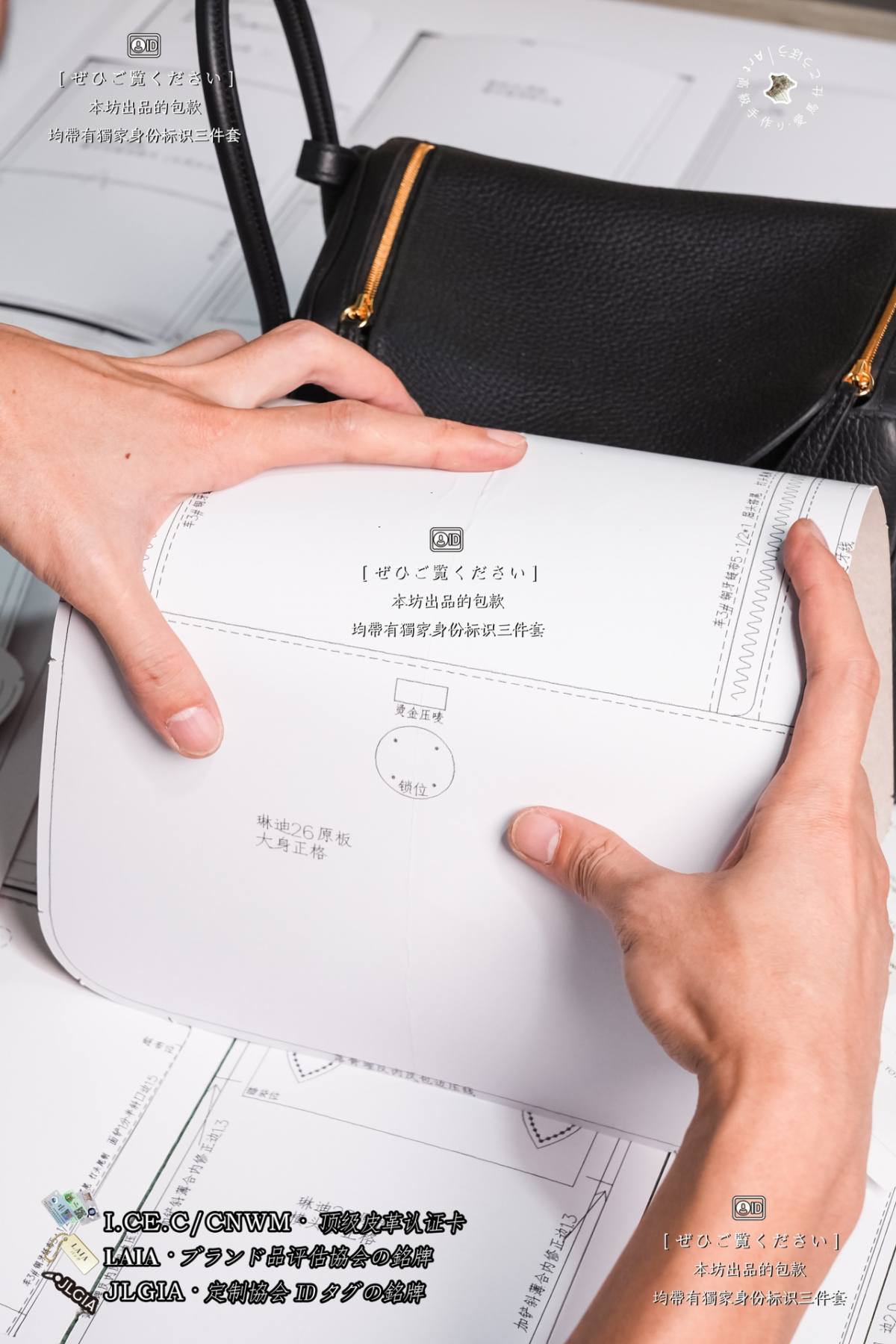
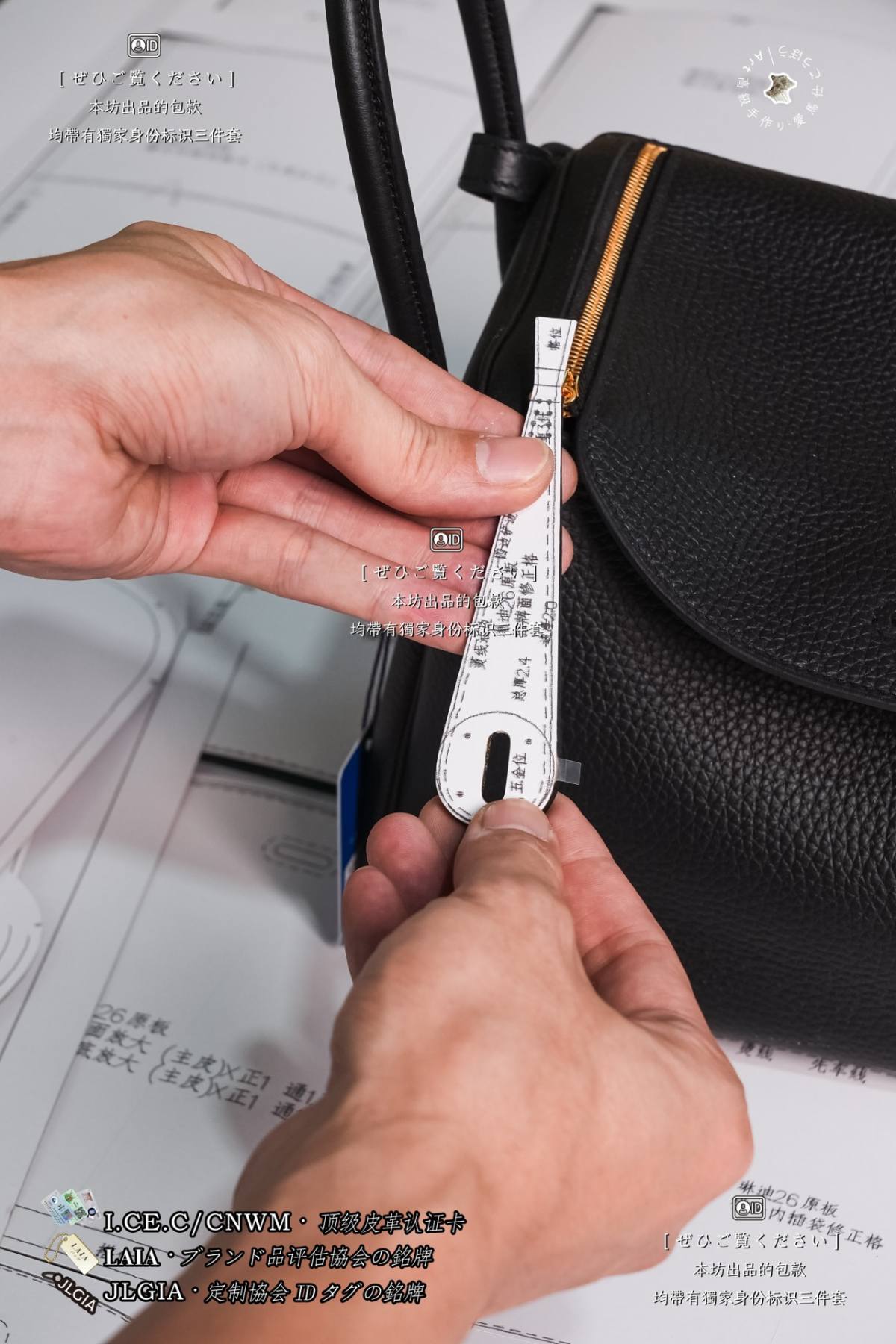
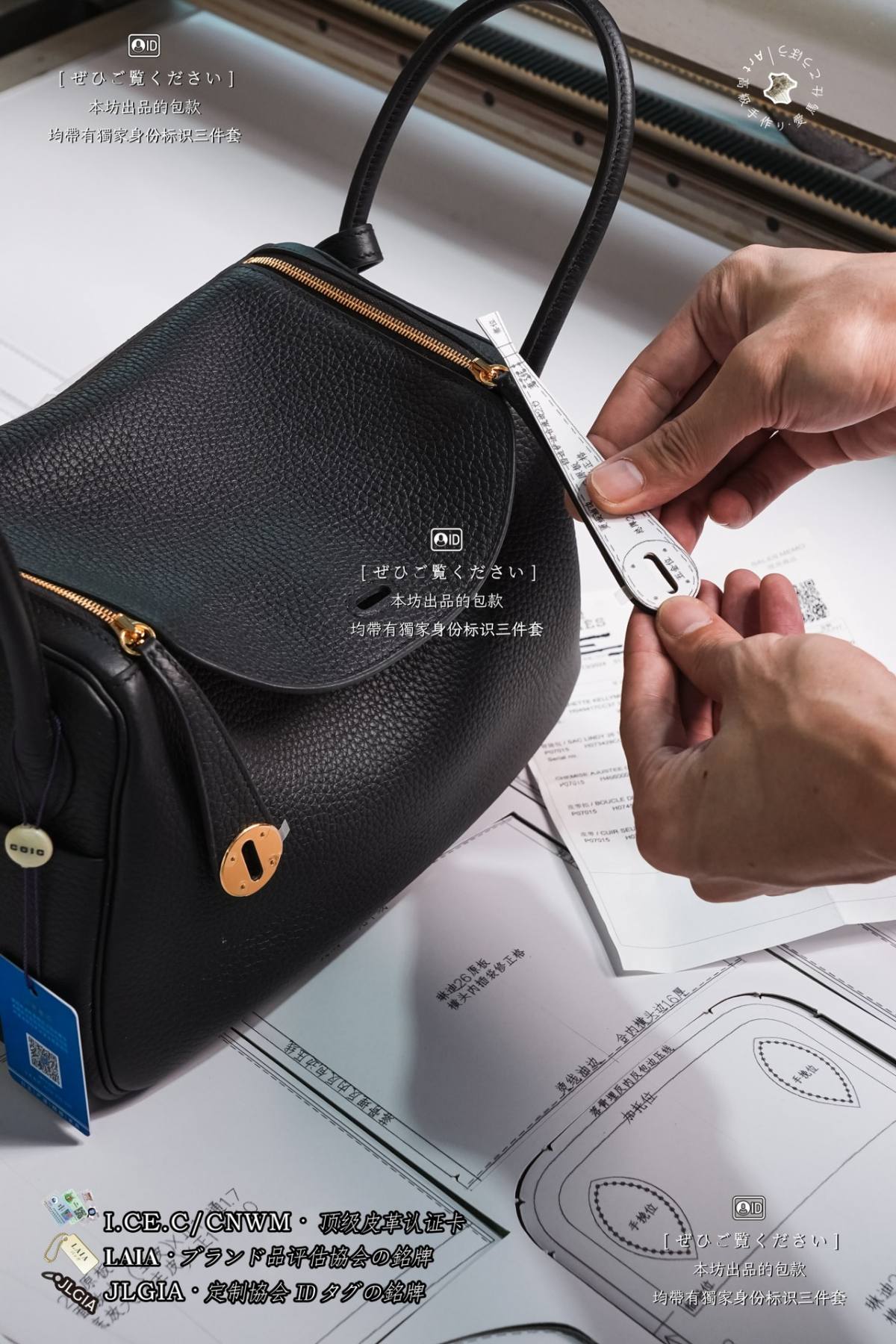
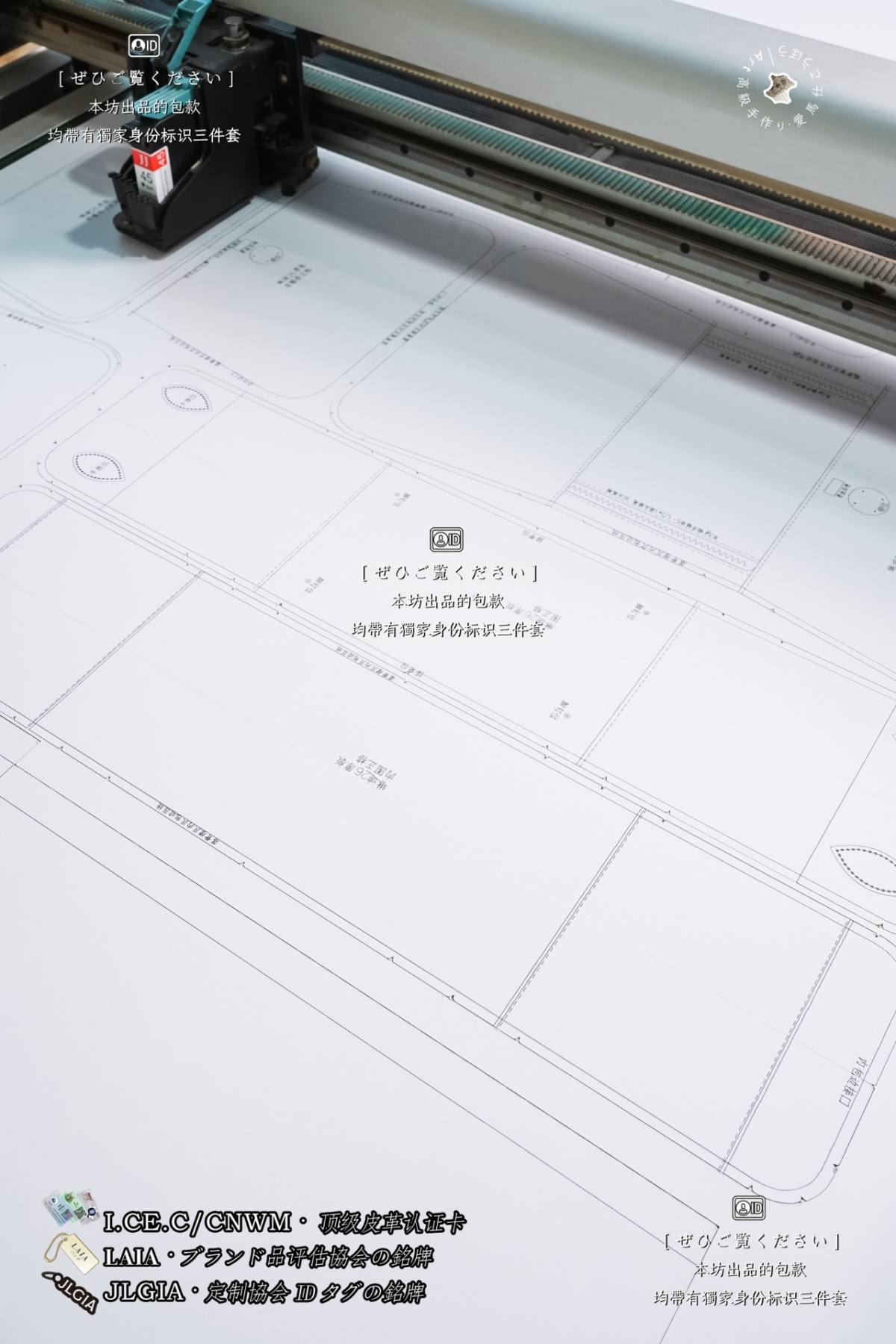
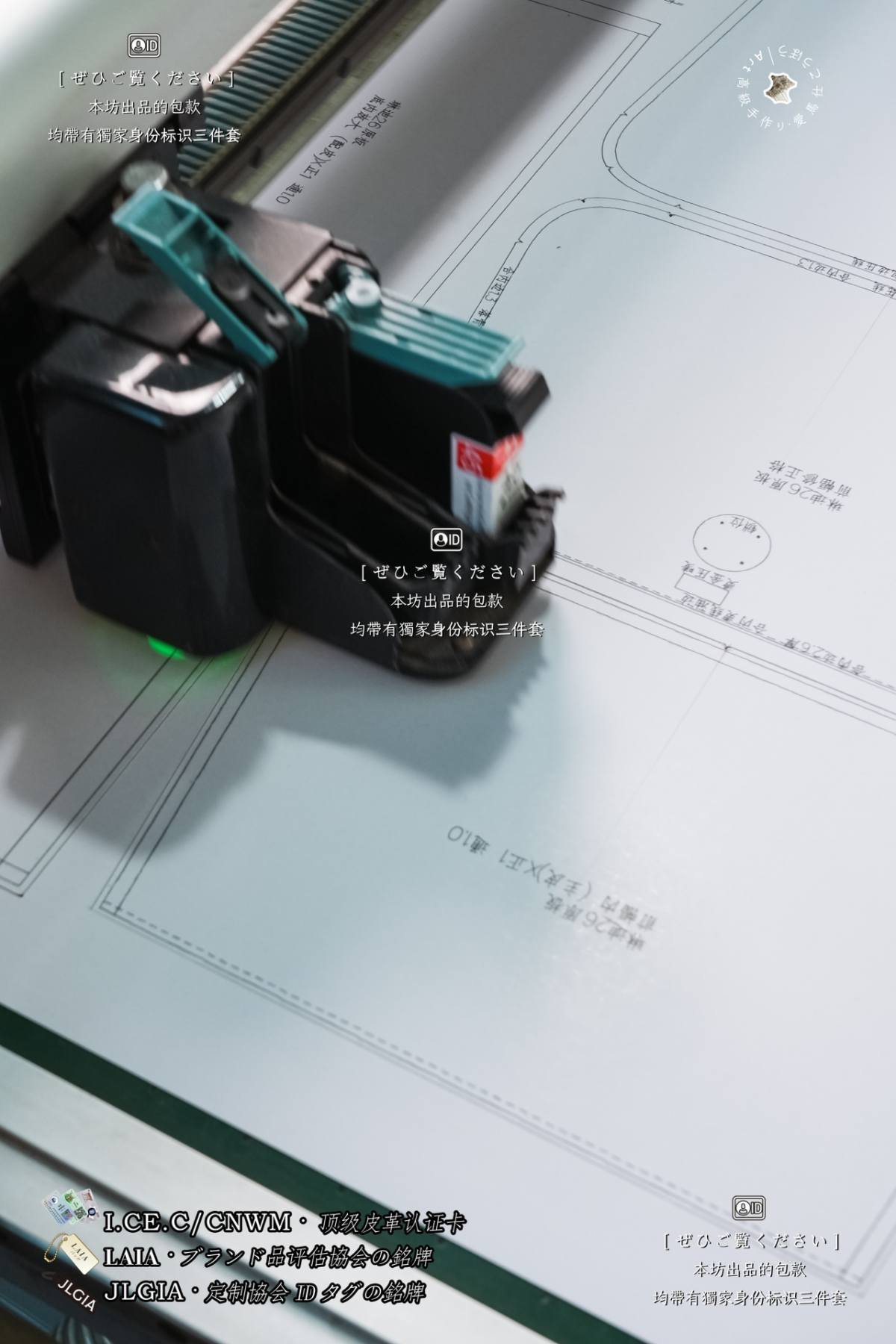
Following the completion of digital pattern design for leather cutting at the Shebag workshop, physical paper templates are printed and produced accordingly. Template engineering stands as a core technical capability, directly governing dimensional accuracy and the structured curvature of finished bags, serving as an indispensable foundation for high-fidelity 1:1 replication. This overview outlines the standardized development and production procedures adopted by Shebag.
Benchmark dimensions are formulated based on authentic product measurements, with the Hermès Lindy 26 defined at 26 centimeters in width, 18 centimeters in height and 13 centimeters in depth, maintaining a tolerance margin of plus or minus 0.2 centimeters. The upper opening spans 26 centimeters, while the base width measures 24.5 centimeters. The front and rear panels share a uniform height of 18 centimeters, and the side gussets deliver a structural thickness of 13 centimeters. The handle features a natural drop height of 10 centimeters, and the full-length shoulder strap extends approximately 90 centimeters with an effective wearable drop of 27 centimeters.
The complete template set consists of 22 primary components divided into exterior and interior structural parts. The exterior leather assembly incorporates one front panel, one rear panel, a pair of symmetrical side gussets, one base panel, dual exterior side pockets, a pair of top handles, two handle connection reinforcement pieces, one adjustable shoulder strap, two strap anchor tabs, one lock closure flap and four base stud reinforcement patches. Supplementary interior components include lined front and rear panels, interior side gussets, inner pocket linings, rigid structural backing materials, zipper mounting patches and edge binding strips to enhance structural integrity and finishing quality.
Core cutting dimensions reference raw template measurements excluding seam allowances. The front panel features a top curved profile with symmetrical 4.5 centimeter corner radii, measuring 26 centimeters across the upper edge, 24.5 centimeters along the base and 18 centimeters in overall height. The rear panel mirrors the same horizontal and vertical dimensions with a straight upper edge and no curved contouring. Symmetrical side gussets stand 18 centimeters tall and 13 centimeters wide, contoured with upper edge curvature engineered for seamless alignment with front and rear panel profiles and a straight lower edge for secure base assembly. The rectangular base panel measures 24.5 centimeters by 13 centimeters with rounded 1.5 centimeter corner radii. Exterior side pockets are constructed at 12 centimeters in width and 14 centimeters in height, with a 2 centimeter allowance for upper edge folding. Each single handle blank spans 38 centimeters in length and 2.2 centimeters in width, with 45-degree angled trimming over a 3 centimeter segment at both terminals, and a 1.2 millimeter rigid box calf reinforcement embedded within central weight-bearing sections. The full-length shoulder strap is produced at 90 centimeters long and 2.0 centimeters wide, built with a dual-layer bonded structure and 1.0 millimeter intermediate structural backing for balanced rigidity.
Precision seam allowances and technical compensation protocols are implemented to preserve structural consistency and silhouette definition. A standard 0.8 centimeter seam allowance is applied to all primary joining seams, while perimeter edge finishing sections adopt a reduced 0.5 centimeter margin. Curved contours along upper front panels and side gussets utilise a 0.6 to 0.7 centimeter allowance paired with uniform notching to eliminate surface wrinkling. Base panel corners incorporate a widened 1.0 centimeter seam margin with dense incremental notching for smooth contour shaping. Integrated handle construction combines outer leather, structural backing and inner lining, achieving a consolidated finished thickness ranging from 3.2 to 3.5 millimeters.
Stitching hole calibration adheres to Hermès original 3.0 millimeter French chisel specifications. Standard punch spacing is set at 0.55 centimeters, translating to a functional stitch interval of approximately 0.45 centimeters, with a 0.2 centimeter perimeter edge margin that reduces to 0.1 centimeters following edge coating refinement. Top handle detailing employs dual parallel stitch rows with 0.6 centimeter spacing, while main panel and side gusset joints utilise single-row stitching with reinforced perforations at angular transition points. Base stud mounting zones feature four-hole square positioning with 1.2 centimeter interval spacing for balanced load distribution.
The template development workflow is structured to minimise revision and production inefficiencies. Initial drafting covers four foundational components including front panel, rear panel, side gussets and base panel based on raw dimensional specifications. Three-dimensional contour alignment verifies precise matching between upper gusset curvature and front panel arc profiles, followed by comprehensive marking for seam margins, relief notching and stitching perforation positioning. Secondary template sets are then finalised for handles, shoulder straps and auxiliary pocket components. Interior lining templates are calibrated to a marginal reduction of 0.1 to 0.2 centimeters relative to exterior panels to prevent lining tautness and surface distortion. All finalised templates undergo mechanical cutting and edge refinement to ensure complete bilateral symmetry and dimensional uniformity.
Key design nuances derived from original Hermès construction principles are integrated to replicate authentic silhouette characteristics. Asymmetrical dual-radius contouring is applied to the front panel upper edge, with an outer arc radius of 4.5 centimeters and an inner arc radius of 4.2 centimeters to enhance three-dimensional visual depth. Upper side gusset profiles incorporate a 1 millimeter inward contour adjustment to naturally narrow the bag opening and maintain structural closure. Pre-engineered two-degree arched shaping is embedded within handle templates, enabling ergonomic hand conformity in finished products. Perimeter base panel flaring expands the lower foundation by 1.5 centimeters relative to the upper opening, delivering enhanced upright structural stability and resistance to sagging. Transitional corners across all components utilise refined 0.3 centimeter micro-radius finishing, eliminating sharp edges and delivering consistent smooth tactile quality after edge coating treatment.