- 04
- Jul
Shebag Lizard leather double stitching craftmanship review(July 2026 updated)
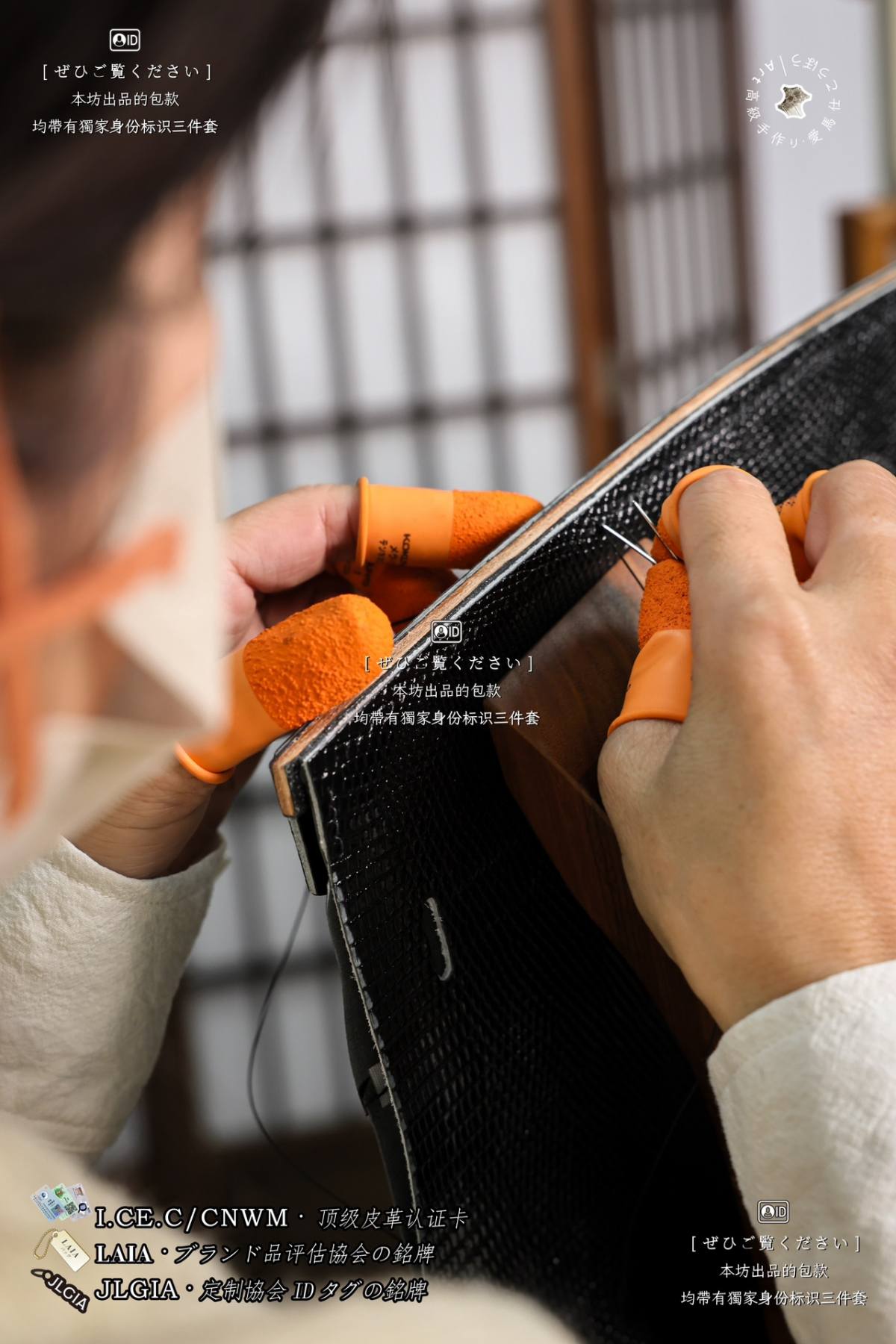
Lizard skin comes with inherent drawbacks: it is extremely thin, measuring only 0.5 to 0.8 millimeters, equipped with brittle scales and dense, non-resilient fibers. It develops split stitch holes easily, scales curl up under minor tension, and its delicate grain is prone to damage from stitching lines.
Directly applying conventional saddle stitching will lead to cracked scales, elongated needle holes, uneven stitches and curled flakes. Shebag has developed a full set of customized improvements exclusively for lizard skin, standardizing every step of the entire workflow including pre-processing, hole punching, thread selection, hand stitching techniques, thread finishing and post-treatment, to deliver luxury-level double-wave saddle stitching.
The foundation of preventing scale cracking lies in thorough pre-processing of raw hides. Each piece of natural lizard leather is ultra-thin; two layers stacked together reach a total thickness below 1.6 millimeters. Direct stitching would result in saggy material and torn needle holes.
The back of each hide undergoes gradual 45-degree bevel skiving, thinning the stitching track down to 40 percent of the original leather thickness. Edges feature seamless natural transitions without uneven steps, creating consistent thickness when two layers are bonded. An ultra-thin fiber reinforcing lining is inserted between the joined layers, laid only along the full stitching path without covering the front scaled surface, striking a balance between structural strength and visual appeal. Low-penetration white adhesive is used for bonding, applied in a thin 1-millimeter strip only along edges to stop glue seepage onto the front, which would dull the natural luster of scales. The leather is left to fully air-dry before any hole punching commences.
Dry, rigid lizard scales tend to crack along edges under the pressure of punching. A low-temperature atomized specialized vegetable-tanned conditioning oil is lightly misted onto the leather surface. It softens internal fibers without leaving greasy residue on top, boosting the flexibility of scales so they resist chipping during perforation. Pattern layout is carefully planned to avoid placing dense clusters of large scales along primary stitching lines; sections covered with fine, small scales are reserved for saddle stitching to minimize visible imperfections.
Luxury-grade 45-degree angled perforations eliminate scale splitting, a feat achieved with Shebag’s custom diamond-shaped angled pricking irons engineered solely for lizard skin. Standard straight vertical punches tear scales horizontally when pressed through leather. A spacing gauge sets a uniform standard stitch length of 3 millimeters, with all holes positioned 2.8 millimeters away from leather edges. A shallow groove is indented along the stitching line to embed threads flush against the hide, preventing raised stitches from scraping scales. The core advantage of 45-degree angled punching lies in the consistent slant of the iron teeth, tilted lower on the left and higher on the right at a 45-degree angle. The tool penetrates the leather diagonally, creating diamond-shaped angled tunnels for needles. Tensile force disperses along the natural grain of scales instead of pulling horizontally to split them. Perforation is completed in two stages: a light initial press leaves faint indentations, followed by one steady full thrust through the hide. Repeated jabbing that chips scale edges is strictly avoided. For curved corners, individual diamond awls are used to fine-tune hole placement, maintaining perfectly even stitch spacing along all arcs. After punching, a thin awl gently smooths the inner walls of each hole to remove burrs that would catch and tear scale edges during threading.
Specially matched threads and needles are selected to fit thin lizard leather without indenting its scales. Unlike thick threads made for crocodile hide, lizard skin requires fine-gauge cord. The triple-waxed linen thread used here is 0.35 to 0.4 millimeters in diameter, one grade finer than standard luxury leatherworking thread. It reduces material packed inside each hole, stopping overstretched perforations and indentations across scales. The cord is fully saturated with natural beeswax under high heat, forming an even, smooth wax coating that glides through holes without scratching scales or abrading the fragile fibers of lizard hide. Thread lengths are cut five times the full length of each stitching track as a single unbroken strand; splices mid-stitch are forbidden, as inconsistent tension at joints pulls and warps scales.
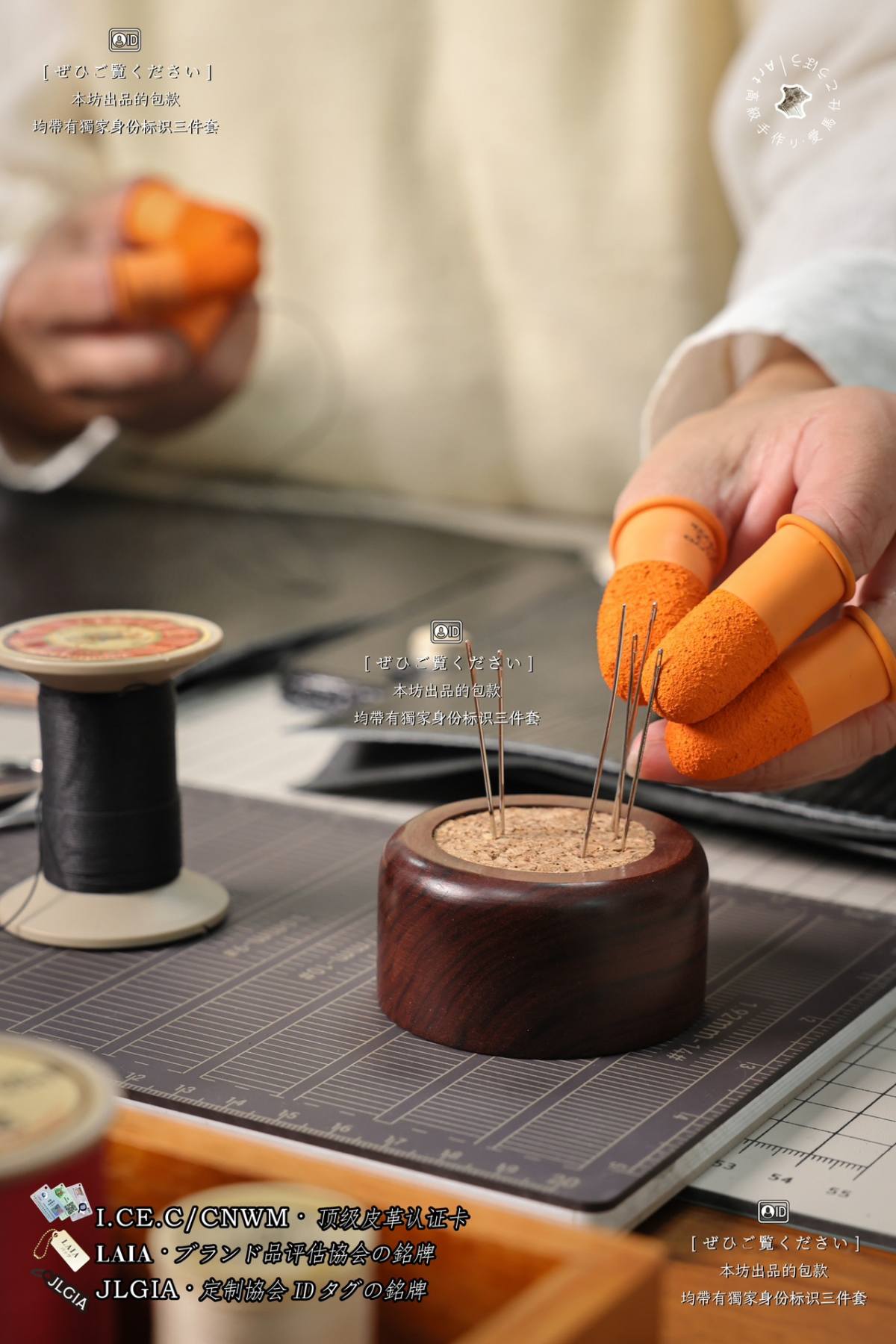
Fine blunt-tipped leather needles from British brand John James, Size 2, are adopted for construction. Their smooth rounded points cannot pierce the base layer of scales when passing through perforations. The needle shaft diameter is calibrated to fill roughly 75 percent of each angled hole, locking threads securely without stretching and splitting thin leather. Both ends of the double thread are anchored with reinforced lock stitches: each needle tail pierces its own cord three times to form a permanent lock, eliminating loose needles and mid-work rework.
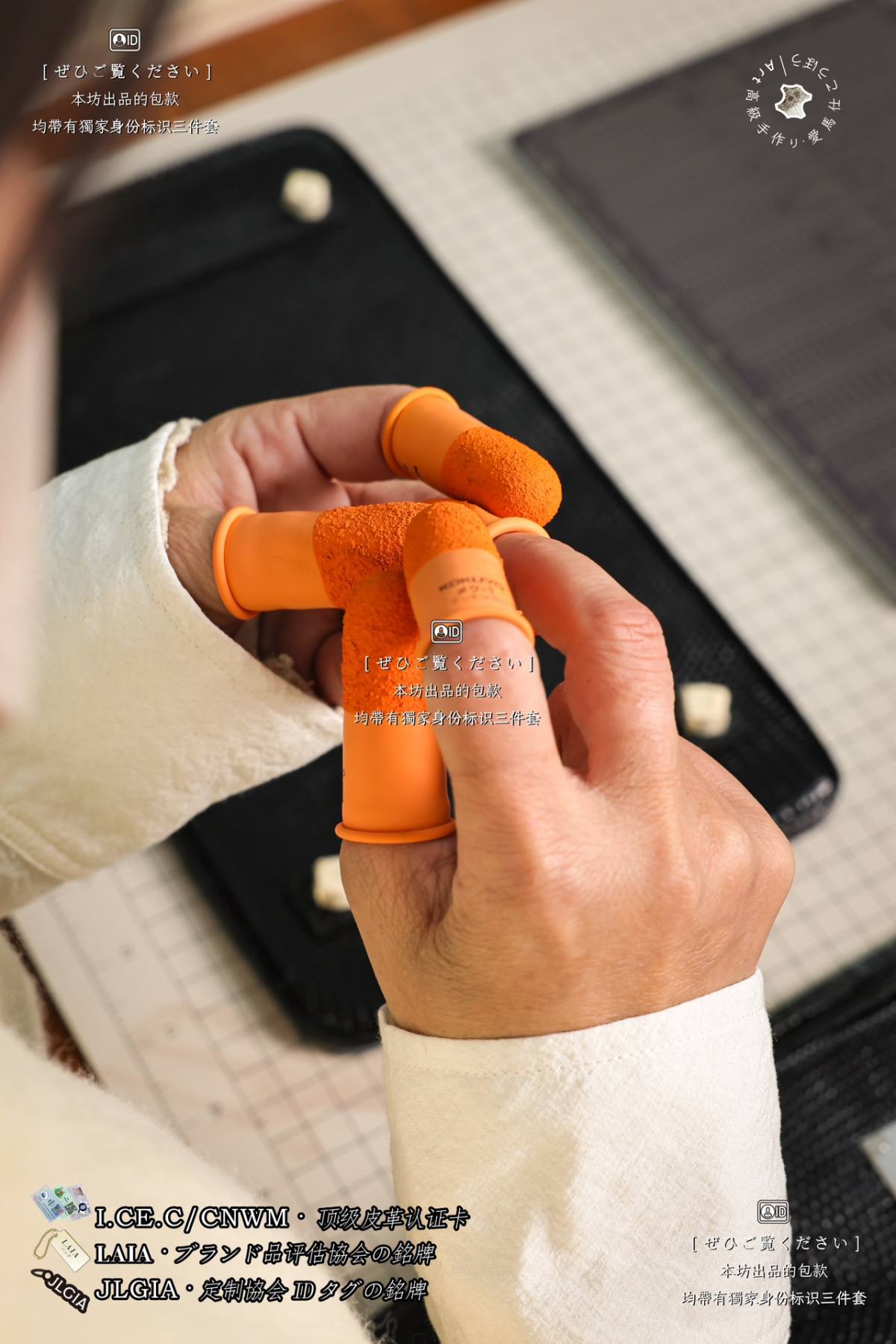
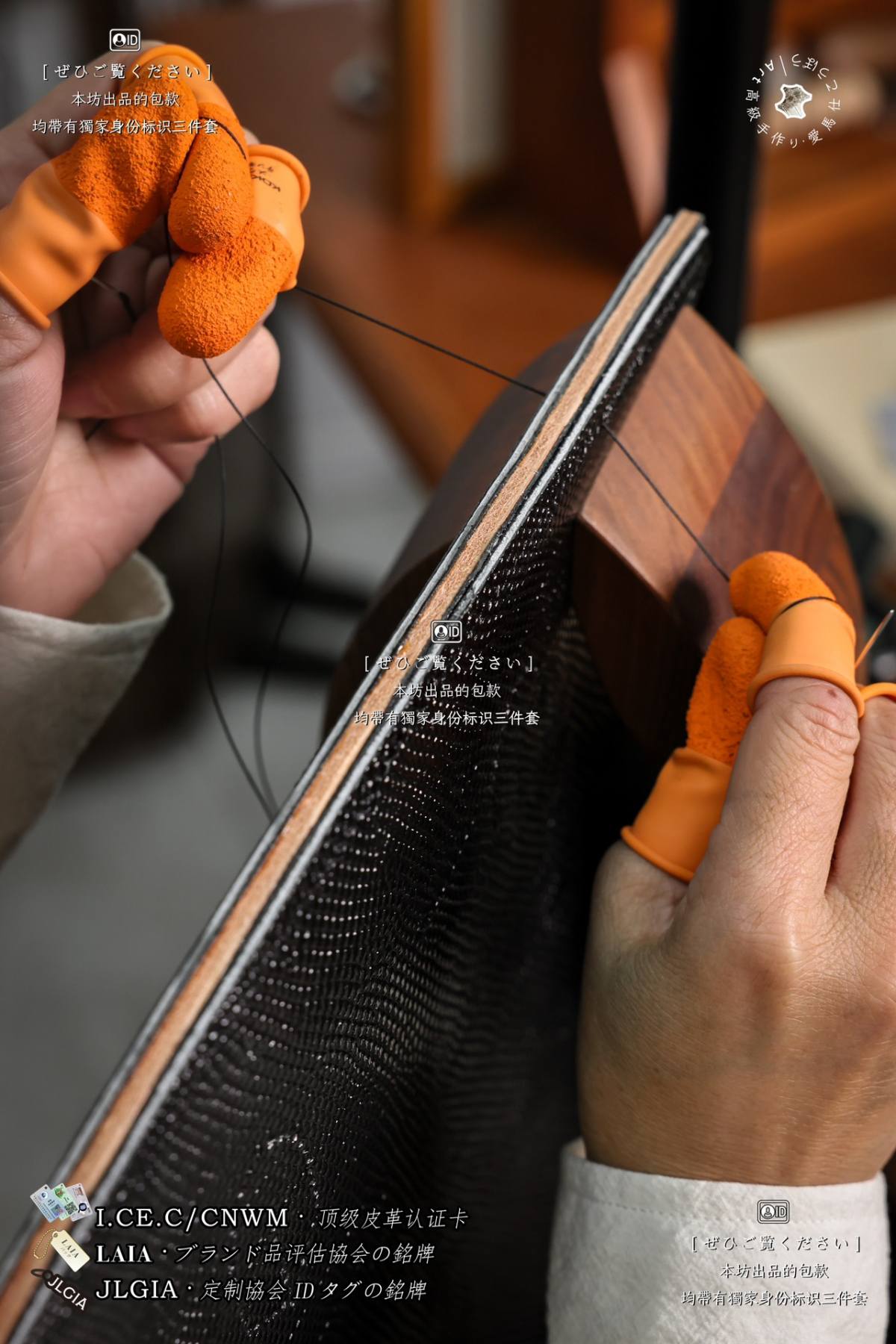
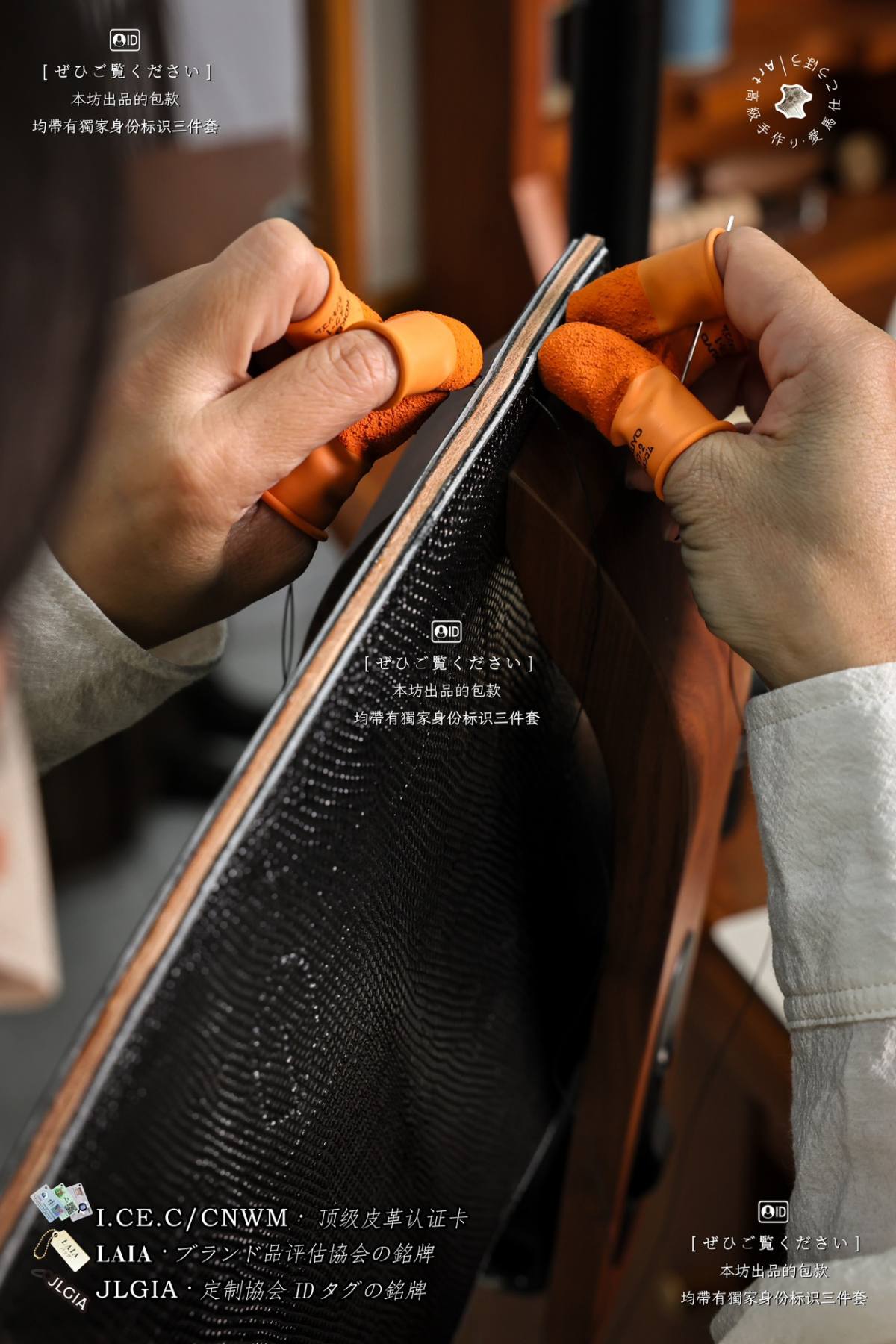
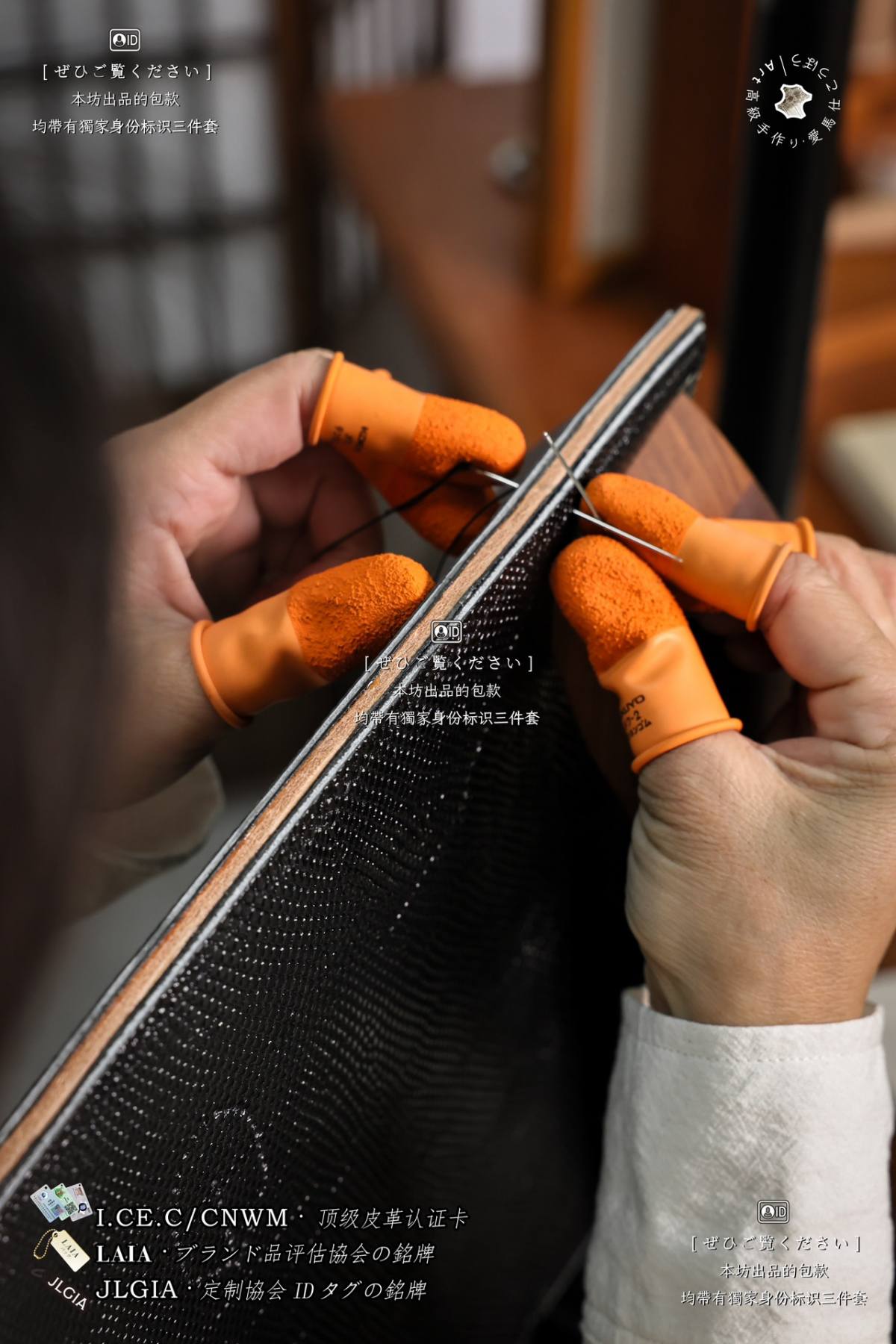
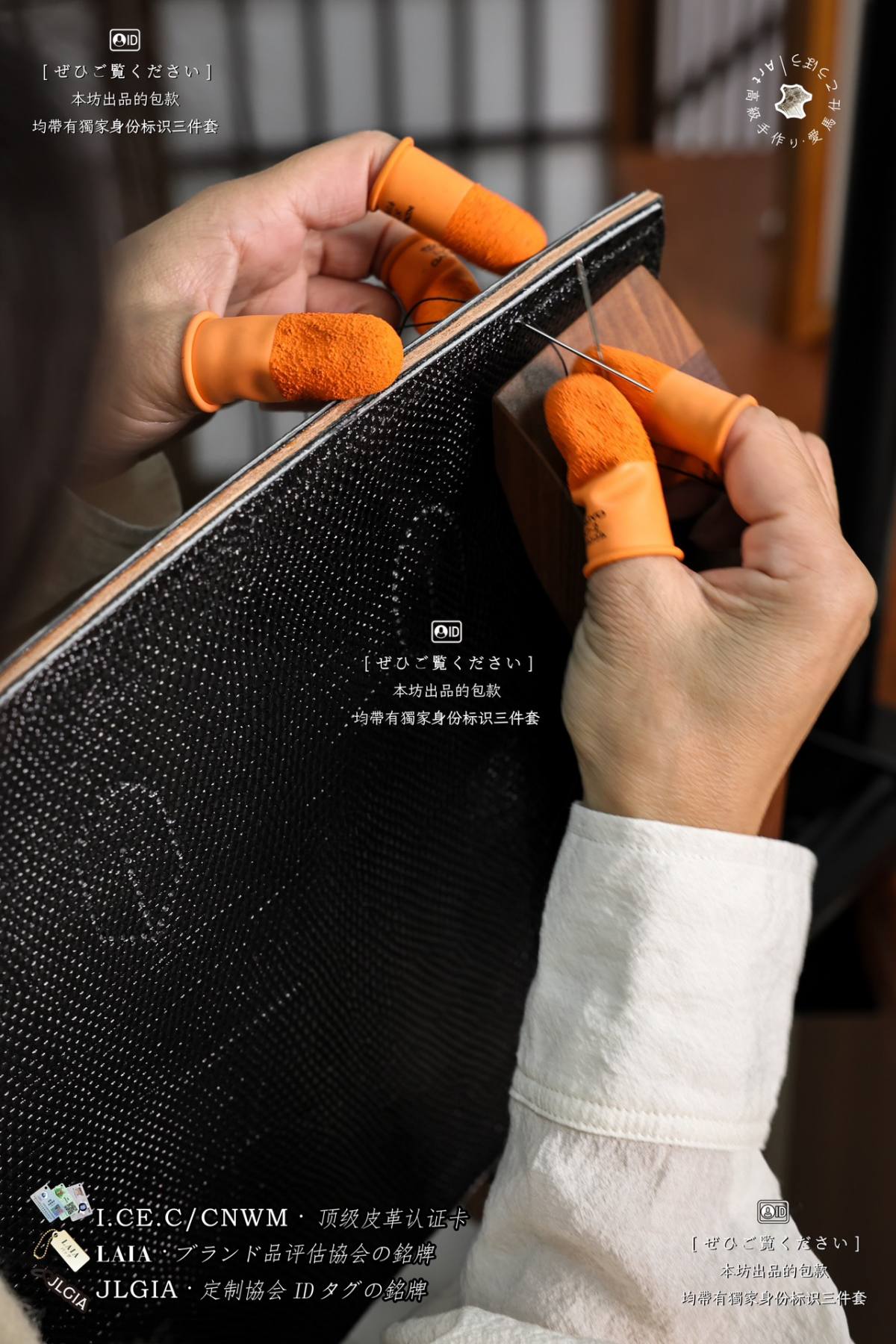
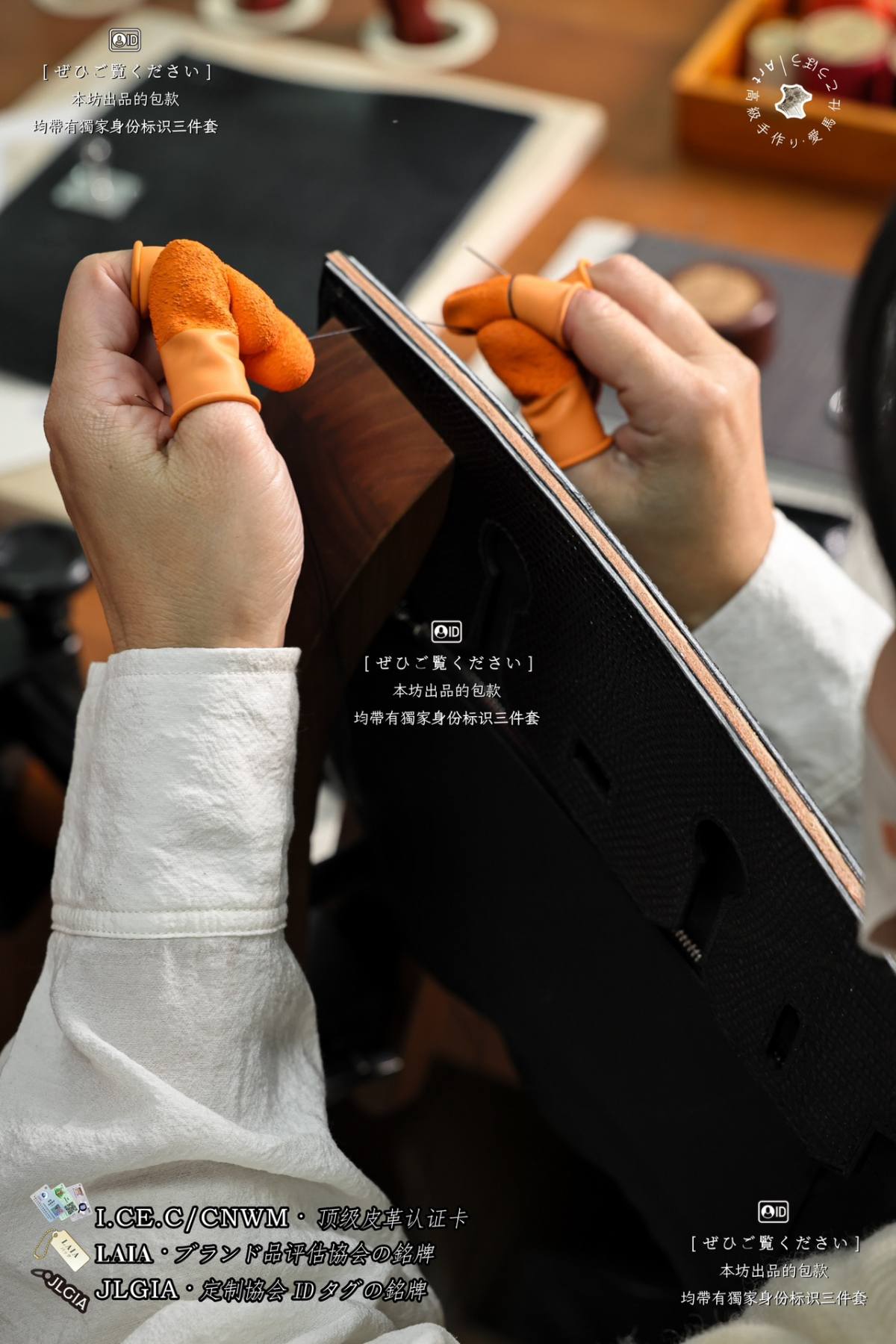
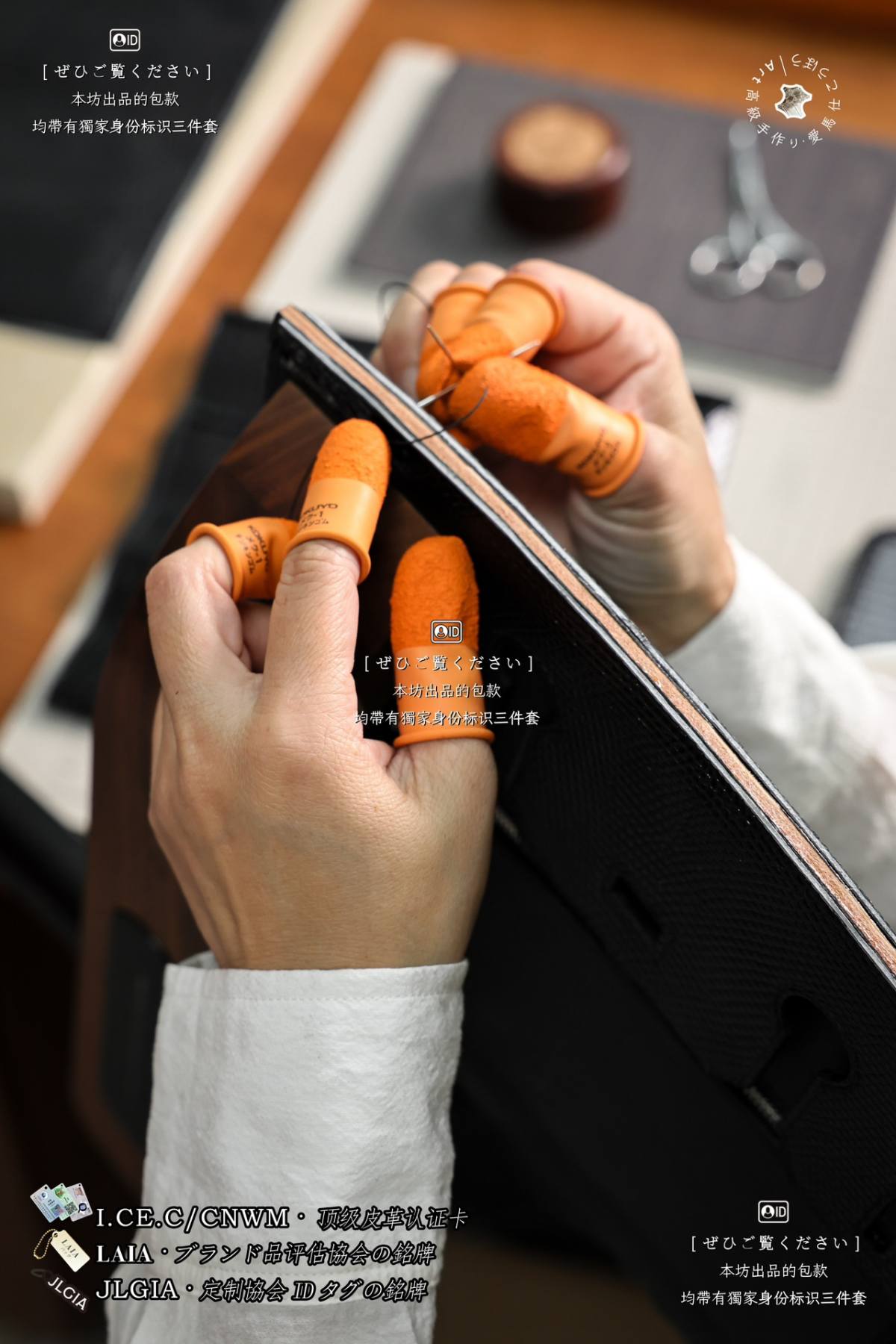
Standardized double-needle single-thread saddle stitching forms the core hand-sewing technique, producing symmetrical double waves on the leather front and a perfectly smooth, mark-free reverse side. Every stitch delivers identical tension and entry angles, designed specifically to resolve the issue of curled scales from uneven pulling. Locking begins at the first hole: the dual thread is split evenly through the center, with diagonal tension applied front-to-back and top-to-bottom via the left and right needles. One-sided pulling of the hide surface is prohibited to prevent unilateral curling of scales. The standardized cross-locking sequence follows strict steps. First, the left needle enters the hole at a 45-degree diagonal from the front without being fully pulled through, leaving a loose loop. Second, the right needle passes through the same hole behind the loop, wrapping and interlocking the cord to form an independent knot, the key difference that transforms single-wave stitching into symmetrical double waves. Third, both threads are pulled taut simultaneously and evenly along the 45-degree diagonal of the angled hole, with equal tension maintained on both sides and harsh single-sided yanking banned. Fourth, each completed stitch is gently pressed to reset displaced scales and stop curling caused by tension. Special control is enforced around curves and corners: stitching speed slows, and tension is subtly adjusted at every hole to narrow gaps in thread force, preventing cracked scales and irregular stitch density along arcs. Mechanically, each saddle stitch creates an independent self-locking knot. If one segment of thread snaps, the entire seam will not unravel. High-load areas such as hand straps and bag bases receive extra reverse reinforcing stitches for durability.
Hidden reverse locking stitching eliminates raised bumps on the leather reverse that would press against and lift front-side scales, a critical risk given lizard skin’s minimal thickness. Upon reaching the end of a stitching track, two to three reverse stitches are sewn inward to form concealed internal knots, with no exposed bulky ties. Thread tails are tucked into the middle of the leather laminate, trimmed to a mere 0.5 millimeters. A low-temperature copper iron tip lightly melts the waxed thread ends to seal them, embedding the melted residue fully within the interlayer. Large protruding knots on the back are completely eliminated, preventing long-term friction and bending stress that crack scales from underneath.
Post-stitching shaping and scale restoration determine the final refined texture of finished goods. A custom wooden stitching mallet taps lightly along every seam, pressing threads fully into pre-indented grooves so cords sit flush with the leather surface with no raised indent marks. Slightly curled scales are revived with a thin application of low-temperature conditioning oil, manually flattened and left to air-dry and set permanently. A thin mist of matte scale-protecting wax is sprayed across the entire piece, filling tiny gaps within needle holes. This treatment delivers waterproofing, locks threads firmly in place, stabilizes scales, and softens the visual prominence of perforations. Final quality inspection is conducted under natural light from multiple angles, verifying uniformly curved double-wave stitches, stitch spacing deviation controlled within 0.1 millimeters, zero split or indented scales, and no skipped or twisted threads anywhere on the leather.